See New Driver Hub in action
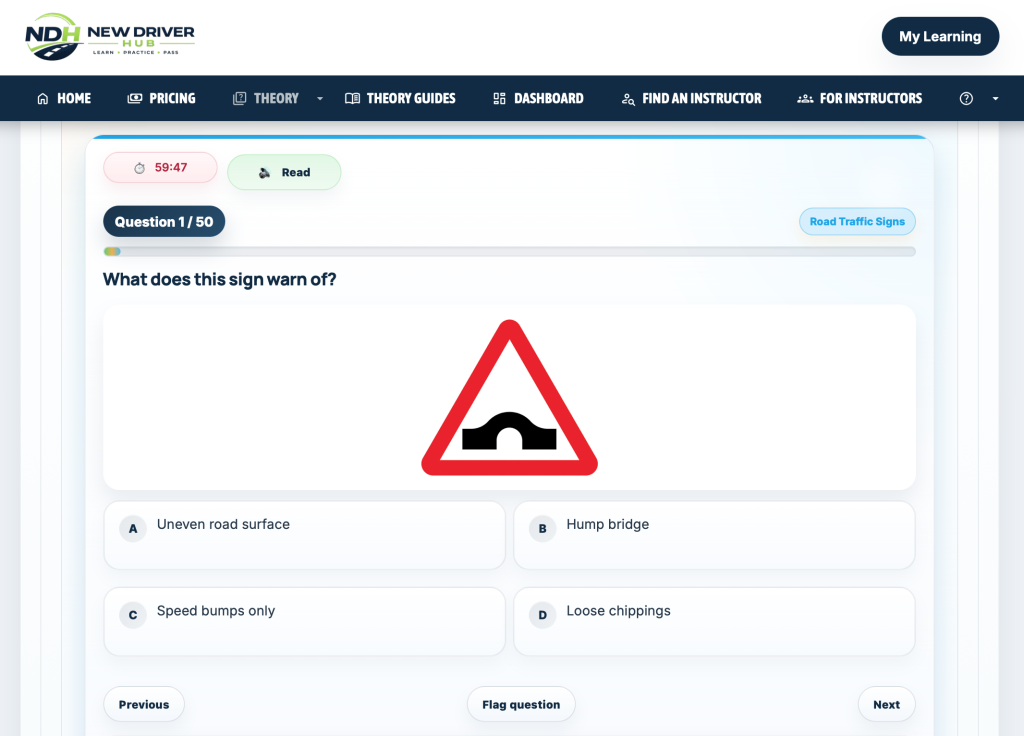
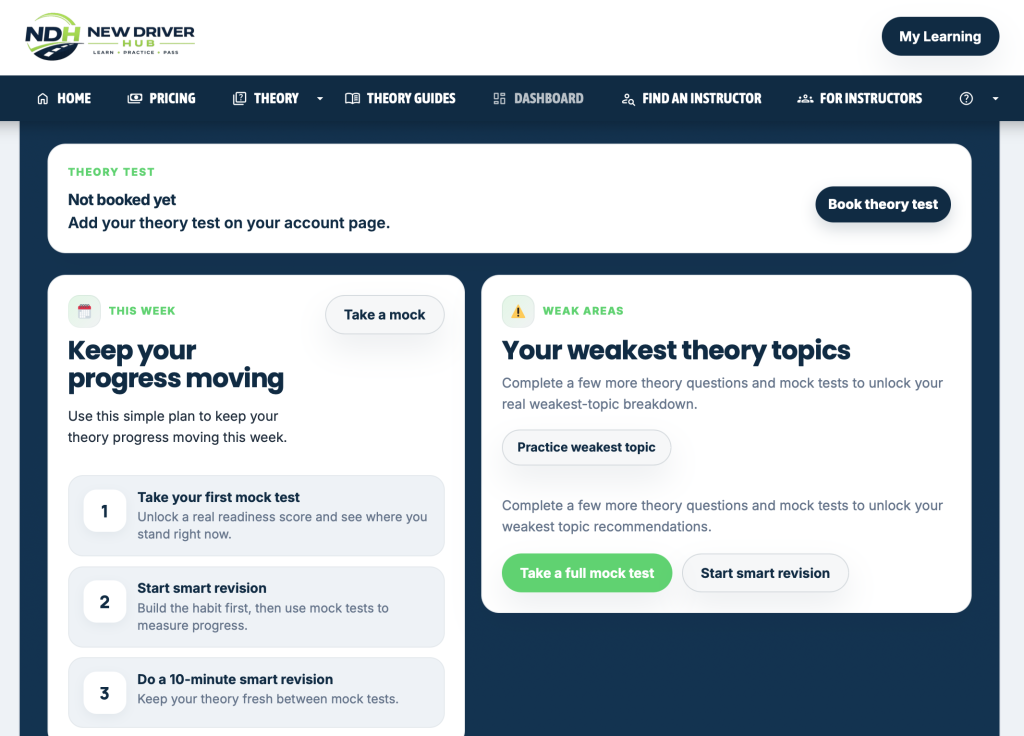
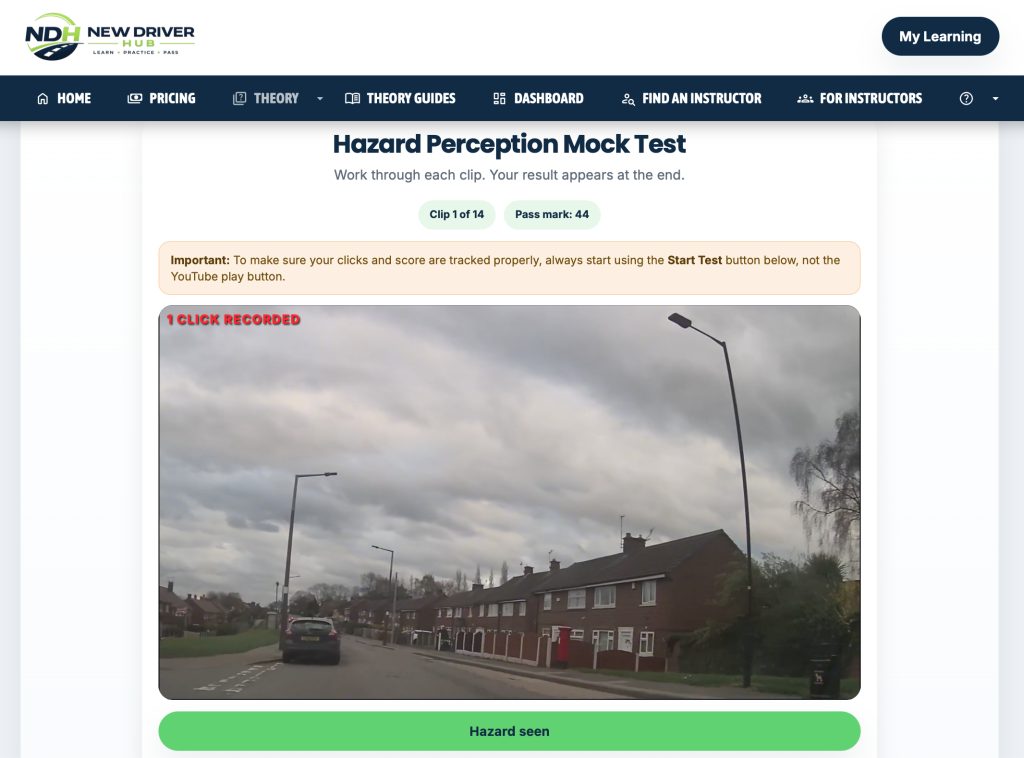
Free theory test practice, full DVSA-style mock tests, hazard perception and a smart dashboard that shows exactly what to revise next — all online, with no app to download.
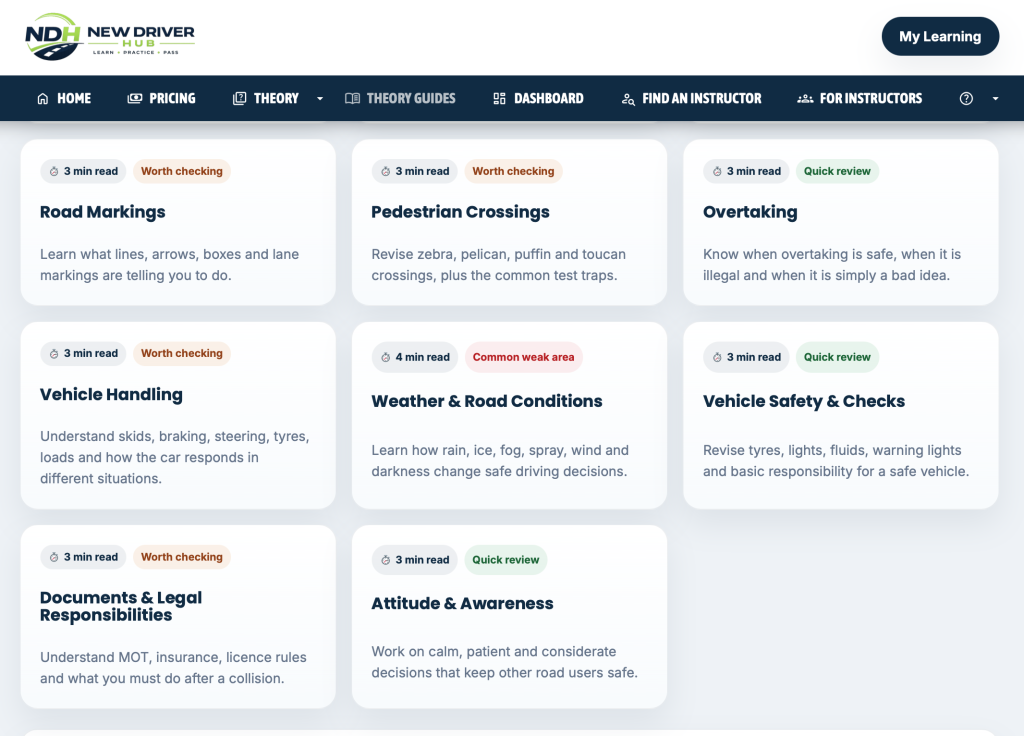
Start with the area you find hardest, then move into full mock tests once your scores begin to climb. These pages are built to help you revise by topic instead of guessing what to do next.
Learn the shapes, colours and meanings that come up again and again in the test.
Open topic page →Fix lane choice, signalling and the rules that catch learners out most often.
Open topic page →Memorise the key distances and understand what makes them change.
Open topic page →Get better at spotting risks early before they turn into problems.
Open topic page →Cover lanes, signs, smart motorways and safe motorway driving rules.
Open topic page →Build confidence with the everyday rules that support stronger scores overall.
Open topic page →Browse the complete reference of UK road signs with the official imagery, plain-English meanings, and real examples of where you'll see each one. Free to browse, free to test yourself on, and built to make the road-signs section of the theory test feel obvious.
Every UK theory test centre on one page — address, postcodes, parking notes and how to get there by public transport. Use it to plan your test day, then practise free first so you walk in ready.
£8.99 one-off for 99 days access. Get full mock tests, hazard perception training, Smart Practice and progress tracking in one place.
Most learners pass within one cycle, so you get enough time to revise properly without paying for access you do not need forever.
To pass your UK driving theory test, you need to understand two parts: the multiple-choice questions and the hazard perception test.
The multiple-choice section includes 50 questions covering road signs, rules of the road, stopping distances and safe driving techniques. You need to score at least 43 out of 50 to pass.
The hazard perception test uses video clips to assess how well you can spot developing hazards. You can score up to 5 points per hazard, with a total pass mark of 44 out of 75.
The best way to prepare is by combining regular practice, full mock tests and reviewing your weak areas. Start with free theory practice, then unlock mock tests with Theory Pack, and learn how the clips are marked in the hazard perception guide.
Use the platform in the order that helps most learners pass faster: build knowledge first, test yourself properly, then focus revision on the topics that still need work. Read the full theory test guide →
Start with unlimited topic-based questions at no cost. No account required to get started.
Start free practice →Take full timed mocks, see your readiness score, and understand which subjects are pulling your score down before test day.
Take a mock test →Use Smart Practice and subject guides to focus on your weak areas instead of wasting time on topics you already know.
Open revision guides →Use hazard perception practice, revision guides and your dashboard together so each next step is obvious.
Open your dashboard →Your dashboard pulls together everything — readiness score, weak topics, mock history, streak, test dates and next best action — so you never open the site wondering where to start.
New Driver Hub gives learners a clear way to practise for the theory test, see their weak areas, take full mock tests and build confidence before the real thing.
£8.99 one-off for 99 days access. No subscription, no long contract, and enough time for most learners to revise properly.
See what is included →Free question practice is useful, which is why New Driver Hub includes it. The difference is what happens after the questions: weak-area tracking, timed mocks, readiness scoring, revision guides, hazard perception support and a clear next step.
Start free, then unlock Complete Theory Access for £8.99 one-off. That gives you mock tests, Smart Practice, hazard perception tests, revision guides and your progress dashboard together, while hazard perception practice stays available in Free.
One payment. No subscription. Built for learners who want more than a question bank.
Refer learners via your unique link, track who's active and how they're progressing, manage your Find an Instructor listing, and earn commission on referrals — all from one instructor hub.
School accounts bring learners together with teacher dashboards, class score snapshots, challenge mode, theory and hazard reports, and printable certificates for students who pass both parts.
Most learners do better when they understand the format, the pass mark and how hazard perception scoring works before they dive into revision. These guides and tools are built to help you revise in the right order instead of just guessing.
You need 43 out of 50 on the multiple-choice part to pass. Hazard perception is separate, so the best prep is to build knowledge with topic practice, then move into timed mocks and hazard clips.
Read the full guide →The multiple-choice test has 50 questions. That is why New Driver Hub includes full timed mocks — so you can practise the real format, not just short quizzes.
Try mock tests →Hazard perception is about spotting developing hazards early. You score more points for clicking at the right time, not for clicking wildly. Practice clips help you build the timing.
Read the hazard guide →Read the plain-English guide covering case study questions, hazard perception clips, Highway Code updates and what has stayed the same.
Read theory test changesStart with free practice today. No account needed to get going — create one when you're ready to track your progress.